Sunday, August 17, 2008

Pictures

The dance contest.
To view more recently added pictures, click here.

Dancin´ In the Streets

After leaving Huaraz, I headed further south to Lima to visit my host-family from training. Even though I had not been back for around 8 months it felt almost like I’d just left. That evening I took a night bus with my host-sister and a cousin to Huancayo, a high-altitude city (3244m) in the central sierra. Upon arrival we headed for Sicaya, a smaller town capping a hill fifteen minutes out from the city. Huancayo is a pretty basic city, functional but not too charming. However, Sicaya, a quaint, bucolic town with rolling streets and sweeping views of the surrounding farmlands, feels a world apart. Most of the houses are aging, and the older women still wear traditional dress—big skirts, shawls, and peculiar hats. My host-mother grew up there and every year she and the family return for the annual celebration of Santiago.

We, as in me and at least 20 other people, stayed in the house of my host-mom’s parents. That’s 20 people for about 7 beds. But I’m not complaining; I feel very privileged that I was able to stay with such a hospitable family. They treated me like a daughter.

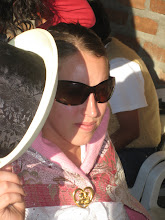
Within minutes of my arrival, the grandma was already fretting about where she could get me a costume to ensure my participation in the dance competition the following day. No was not an option so I went with the flow. In the end, some kind of elderly aunt decided to let me borrow her costume. Thus, I went dancing through the streets of Sicaya with around thirty members of the extended family—followed by our own personal orchestra— in a large pink skirt and my very own funky hat. Mind you, no one bothered to teach me how to dance the Santiago until we were leaving the house and headed for the competition. En route I guess I kind of picked it up because someone commented afterwards that it looked like I knew what I was doing. However, we did not win the contest.

Following the contest we literally danced our way over to the family’s designated portion of the plaza, where the band continued to play. Every family, of which there were around 60, had its own band as well as its own section of the square. I could barely hear our orchestra due to the neighboring band which was several members stronger. At least 30 to 40 crates of beer were brought in. All activity stopped until the beer was blessed and then the dancing continued. I had my picture taken with a handful of random relatives. Most of them were short old men, who were amused by the sight of such a tall white girl wearing traditional clothing. Some random Peruvian tourists also had their picture taken with me and my host-sister. Furthermore, I was subjected to a “photo” by a stranger that turned into a video, a fact I realized moments later as the camera started creeping slowly downwards.

Later on we danced our way to a rented locale, where more of the same ensued. The dancing consisted of a mix of huayno, hauylas, and Santiago. I called it an early night because my little host-brother was sick but all around town the dancing and drinking continued for quite some time.

The following day, we put on costumes of different colors and danced to the cemetery. There were people everywhere, with each family visiting the graves of its family members. More beer was brought in and for the first time in my life I got tipsy in a cemetery. A couple of mothers with semi-single sons started arguing over which of them would be my mother-in-law. In fact, a good portion of my time in Sicaya was spent discussing when I was going to find a Peruvian husband. My seven year old host-brother even commented that next year I would have to come again and that I should bring my “chico” along too.

After a few hours in the cemetery we danced back across town to the rented locale and continued with lunch and more dancing. Once again the festivities continued into the night.

I spent a couple more relaxing days in Huancayo before heading back to Chiclayo. Transport back to Lima ended up being a bigger headache than I expected. When we arrived at the terminal in the morning to buy tickets it became apparent that there were lots of people milling around, including lots of police. The bus companies decided to raise the ticket prices up from S/.10 to S/.100 which clearly caused discontent among the people. All of the windows in the terminal were smashed and no buses left that day. I eventually found a bus leaving that night which got me back to Lima just in time for a day bus back to Chiclayo. In all, I spent over 40 hours on buses during my two week vacation.

Canyoning

One pleasant morning in Huaraz, Susan, Val and I decided to wander over to some tour agencies—of which Huaraz has plenty—to get some information about a certain hiking trail. At the first agency we stuck to the topic at hand. In the second, we were coerced into putting our lives into the hands of random Peruvian males and repelling down waterfalls in a remote location outside of town. It started with a simple suggestion by the guide that we join their canyoning tour which was leaving shortly, an offer I immediately dismissed as ludicrous. However, Val’s interest was piqued and she pressed for more information. I recall little of what was divulged about the actual trip, but when the price dropped suddenly from S/.50 to S/.35 something snapped in my brain and I heard myself saying, “Why not? Sounds like a good idea. What else are we going to do?” This I blame on my Grandma Vern, known for mass purchases of canned tomato soup solely because, go figure, Jewel was having a sale.

An hour after signing up, we were on our way. No waivers were signed. Susan was given a helmet that could be knocked off of her head with a light flick. Of the three of us, only Val had been repelling before. Upon arrival, we discovered that another group was already there, just beginning their first decent. Consisting of four thirty-something males, the group preceding us was a sight to see. Basically they were all quite macho until they themselves had to descend. As the first guy went down, the rest yelled words of wisdom and advice, followed by affectionate nicknames like huevón (tool.) Not a single one of them followed the advice he yelled down at his peers.

As our turn approached I think we were all expecting a bit of instruction. That was ignorant. Before I knew it I was handed the ropes and awkwardly attempting to scramble down slick boulders. I was basically calm and unconcerned until a mere 30 seconds later when I reached the edge of a 20 foot sheer drop. Now, I’m not afraid of heights, but I was only 30 seconds in to my first attempt at repelling with no clear instruction on how to actually repel. At this point I was like “Whoa, you want me to do what? I don’t think I get it.” Finally, I just went down, trying to make it less painful as I went. I didn’t even really notice the freezing cold water soaking my body until I got done. I was pretty sure at that point that I never wanted to do it again.

Nonetheless, preceding Susan was well worth it. As Susan dislikes heights, I really don’t know why she agreed to go. She was pretty much wigging out by the time she had to go. It was a good while before she would even budge from her starting position. I was later told that she was in tears and I can vouch for the fact that plenty of obscenities slipped her mouth. A few collisions with the rocks later she made it down safely. Val followed calmly, looking like an expert.

Two cascades later, I was freezing. Literally freezing. But it did get easier and, by the end, it was even kind of fun.

Sunday, July 27, 2008

Fiestas Patrias

Peru is currently in the midst of celebrating Fiestas Patrias, the celebration of its Independence from Spain. As far as I can tell so far, the celebration mainly consists of parades, which is nothing out of the ordinary. Peru seems to specialize in random parades, sometimes for a legitimate reason but usually not. I'm convinced that if I wanted to I could very easily throw my own parade without notifying anyone. It may be unorganized, disrupt traffic, and have no point, but who cares...it´s a parade!

Anyway, because it is a national holiday, Peace Corps gives us four vacation days. Thus, I decided to travel, along with the rest of Peru and three friends, to Huaraz. Located between the Cordillera Blanca and the Cordillera Negra, Huaraz is a bustling Andean mountain city located at 3052 meters above sea level.

Getting here was an experience of course. My friend Susan was put in charge of buying tickets and she opted for the normal bus instead of the one with beds. Mind you it was a night bus, so sleeping would have been preferred. To travel on the one with beds would have cost a whole $3.00 more so maybe that deterred her. She also decided to put us in the two front seats, directly behind the big glass window separating the passengers from the front cabin where the driver and his assistent reside. Now, normally, in Susan's defense, this is not problematic. However, it just so happens that this particular assistant, hired to keep the driver awake on the 10 hour ride, was darn good at his job. In fact, I don't think he could have been better suited for his line of work. He was so good that at three in the morning he was still beating his hands on the dashboard to the raging techno he had a penchant for. The man, who was at least 40, definitely did not look like the techno type. He also had a really loud and distinctive guffaw and a proclivity for using swear words rather heedlessly.

When we finally got there in the morning it was freezing. I packed shoes this time but I still arrived wearing sandals. As the luggage was being unloaded from under the bus one of the compartments popped open by itself and a man crawled out. Apparently he slept under there which had to be an interesting experience given that the bus was snaking through mountains. All in all, the trip was well worth it because the city has some impressive views of some of the tallest peaks in Peru, including the tallest, Huascaran, which tops off at 6768m. The city also boasts its fair share of appetizing restaurants catering to the large number of gringos who come to trek and climb. And there are a lot of them, gringos that is. They are easy to spot of course, standing about a foot above the rest of the crowd and sporting expensive outdoor gear. The prices in Huaraz reflect the tourists that arrive. Aji de gallina that costs S/.3 in Chiclayo can cost you upwards of S/.13 here.

Friday, July 11, 2008

Typical

I actually took the time to wash an apple before eating it, a precaution I never take. Since I was getting over dysentery, most likely caused by food poisoning, I figured it was worth it. Upon opening my newly bought jar of peanut butter I encountered a swarm of ants. After exterminating most of the ants I walked back over to my bowl of sliced apple and stepped on the rim causing the apple pieces to fly everywhere. In the process I’m sure they picked up some more dysentery causing microbes, but I proceeded to apply peanut butter and eat them anyway.

-------

The cricket plague refuses to go away. The other night I woke up to crickets dive-bombing my tin roof. The next morning, I killed roughly 200 crickets, all of which were in my room. More continued trickle down from the cracks in the roof. Across Peru the rooms of fellow PCVs have become maniacal torture centers focused soley on the extermination of crickets.

-------

I lost my wallet the other day, which contained my bank card. I immediately called the Peace Corps office to have them cancel the card. However, a week later when I still hadn’t heard from them I called to check up on the situation to find that, in their words, “A random man called and reported that he had found my wallet in his car. No one contacted you?” Unless I unknowingly propelled my wallet through a car window, this was not feasible. And, I was never contacted by a random man informing me of the whereabouts of my bank card. Needless to say, Peace Corps finally canceled my bank card.

-------

A fellow volunteer of mine has a crush on one of the municipality workers in her area. She called me the other day to ask if a text message she wanted to send him was okay. It read, “Hubo sol hoy día, ahora soy más oscura.” This translates as, “Today there was sun for a brief moment, now I am dark/shady.” What she wanted to say was, “It was sunny today, now I am tanner.”

-------

Without fail I always use the word especie (species) when I am trying to say especia (spice). This leads to some awkward sounding conversations… “I like to put a mix of species on my pasta.” Or “These beans must have a different species in them.”

Presupuesto Participativo: Try Saying That Fives Times Fast

After a temporary suspension of the Presupuesto Participativo, it was resumed last Thursday by two technical specialists from the regional municipality. Basically they started the entire process over, which meant more useless, unproductive hours of hearing the same information repeated again. During the second meeting, Susan started drawing pictures of how to make the meeting better. Some examples: Punching the tech guy in the face, computer failure, chair fight, sedatives. The speaker managed to make a power point presentation that consisted of a mere 6 slides last for 3 hours. When he reached the slide about the environment he got sidetracked for a good 30 minutes before coming around to the topic at hand, at which point he decided to explain the benefits of improved cooking stoves. As he began to explain that traditional stoves consume wood, I figured he would follow through by explaining that the improved stoves are favorable because they consume less wood. Wrong. Out of the blue, he burst into an animated description of how the specific wood burned in the stoves emits toxic fumes and that improved stoves are good because the highly dangerous, life-threatening smoke is funneled outside into the environment. Amazingly, Susan and I made it through that meeting with out injuring ourselves or committing any crimes.

Voting day finally arrived and Susan and I were pleasantly surprised when we were both granted funds for our projects. Nonetheless, the meeting was no exemplary demonstration of democracy. While the meetings leading up to the voting suggested that voting would actually take place, what actually occurred was rather different. First of all, we were presented with a pre-prepared list of the projects that had been accepted along with the funds to be allocated to each. Then each agente participante, a person with the ability to voice their opinion and to vote, was allowed to defend/dispute the decision which had been made with regard to their project. Flaw 1: no actual changes reflecting the opinions of the people were made. Imperceptible word changes were made which appeased the majority, but no critical semantic changes occurred. With regard to the funds allocated, not a single change was made. I raised the point that spending 20,000 soles to improve the bathrooms in the market was absurd, especially given that this project was never previously discussed but randomly appeared on the list of approved projects. Everyone agreed but nothing changed. Flaw 2: there will be no accountability for those projects that have been approved. Take the bathroom project. With regard to the complaint I raised, I was told that any money that remained from the renovation would be used elsewhere. The problem is that elsewhere probably means the mayor’s own pocket. No one was required to turn in a profile of their projects and no research was done to determine how much money the projects will actually cost. All of the money that was designated for projects was listed in nice even sums like 10,000 or 40,000 soles with no breakdown of what that money will be spent on. I’ve heard that it is a common practice to receive the money and then bribe people to write false receipts to account for money that is spent elsewhere. Flaw 3: Peruvian law was blatantly overlooked at least twice. Indeed, I was present as an agente participante despite the fact that this is illegal according to Peruvian law. At the end of the meeting they tried to elect me as the president of the comité de vigilancia, the committee which ensures that the funds are allocated and spent correctly. I pointed out that it was illegal for me to accept the post and that it should be held by a Peruvian who actually understands how the system works. However, they proceeded to elect me to the position of treasurer on the Consejo de Coordinación Local, apparently a very important committee. Given that I don’t have any idea what its function is and that I detest balancing checkbooks, I think it was a bad idea to elect me. Regardless, I gave up arguing the legality of the issue and accepted anyway.

The bottom line is that this process could be a very effective way to distribute funds within the country but it isn’t. Corruption and an uneducated populace prevent it from being a positive step towards sustainable development.

Godmother of a Beautiful New……….Spotlight

Throughout Perú and much of Latin America, nearly every town and community celebrates a patron saint. Currently Pacora, my municipality, is celebrating the birth of San Pablo, the patron saint of the town. While the central day of the festival is the 30th of June, the celebration is already in full swing and I’ve been told it doesn’t end until the 13th of July. For weeks now, the plaza has been completely surrounded by temporary restaurants and vendors, each one blasting a different cumbia song at inordinate volumes. Recently, a really frightening train posing as a children’s ride was set up on one corner of the plaza. I saw it running the other day and I honestly can not imagine putting a child on board, let alone paying to do so. It runs at ludicrously high speeds all the while emitting disturbing noises.

I’m struggling with the fact that this festival is supposedly in honor of a saint. I attended a large mass in honor of the patron saint with my host-mom and even that didn’t convince me. However, that probably had something to with the fact that in the middle of the mass they decided to hold a benediction for recently installed spotlights. Of course no blessing is complete without godfathers and godmothers and I soon found myself holding one of the ten red strings dangling down from the new lights. Mind you, I had no clue what I was being named a godmother of until the next day and, thus, assumed that holding the red string had some more grandiose significance. My host-mom was also included as a godmother, along with 8 other unsuspecting people. After the priest made the rounds blessing the lights, splashing each of us in the face with holy water, we were asked to make a donation. The woman collecting the money paused briefly in front of me but I stared at her awkwardly until she walked away. At this point I assumed we would return to our seats and listen to the rest of the mass. Instead, we were taken to a small room on the side of the church where we were fed. First, they gave us whiskey cocktails. Not what I expected. My mom didn’t drink hers so she gave it to me. I was the only one there that drank two of them and I’ll just say that I was feeling it by the time I was done. The alcohol was promptly followed by chicken and mayonnaise sandwiches. I even would have eaten the chicken, despite the fact that my host-mom thinks I never eat it, but I despise mayonnaise. And knowing that it had come from a bottle that said “Please refrigerate after opening,” directions that had certainly been disregarded, I just couldn’t do it. My host-mom said she didn’t want my sandwich and then proceeded to take a second sandwich from the tray. Thus, I was forced to stuff the large chicken and mayonnaise sandwich into my pocket. That wasn’t awkward. Once we had finished we were brought back into the mass which I sat through somewhat buzzed. I’ll say that it was more entertaining than a normal mass but I didn’t feel any holier for attending.

The next day I met Susan at the fiesta. First we went to the soccer game, where after about an hour we realized we were indeed the only females there. Roughly half of the people there had mullets so we probably should have left. One man tried to pick us up by throwing a rock at Susan’s head. That was ingenious. At one point an older man walked in and, despite the large amount of blatantly obvious empty seating, sat directly next to me. This I contribute to the inexistence of the concept of personal space in Peru; however, once he realized who he was sitting by, his interests turned from the game to us. He passed the rest of the time staring at us with a baffled expression on his face. After the game we went back to the plaza, where we attempted to avoid joining the large quantities of young Peruvians incessantly circling the park. We decided to split a beer which was probably scandalous, since women here don’t tend to drink among themselves, at least not in public. Most of our time was spent people watching and ignoring drunken men. Compared to the first festival I attended back in January, I realized that I now viewed the festival from a different perspective, much more aware of who was there and more accurately able to describe what was going on. Later on we went to the dance, which is unlike anything you would call a dance in the States. The first thing we noticed was that, to enter was to enter accepting your fate in the case of fire. The only entrance and exit was through a tiny door, roughly four feet tall. Due to the current cricket plague, there were crickets everywhere, which made the already dirty locale a bit more disgusting. The crickets did have one upside: they made it easier to laugh at the drunken men who asked us to dance, as they usually approached with one perched like a pet on their shoulders. A trip to the bathroom revealed the grossest bathroom I’ve ever seen, complete with crickets. Imagine many human fluids of different forms and then imagine crickets jumping from those fluids onto your face.

To my surprise I returned to the festival the next day with my host-mother to attend the morning mass. Of course, we had to get there two hours early so we could sit and watch them set up. At 11:05, the local priest came over the loud speakers to say that the bishop from Chiclayo would be arriving shortly and that he was happy to announce that the mass would start on time. I found the announcement somewhat confusing given that the mass was supposed to start at 11:00. We ended up staying in Pacora until 6:00 pm which was somewhat tortuous given that I had no idea how long we were going to stay. We got lunch, not at one of the restaurants, but from a sketchy looking street vendor. Granted, we only paid $1 each, but I consider it a miracle that I suffered no ill effects. As we were leaving I had to laugh when a group of men offered me a drink only to receive a death glare from my host-mom. It shut them up immediately. If you’d seen it you would understand.