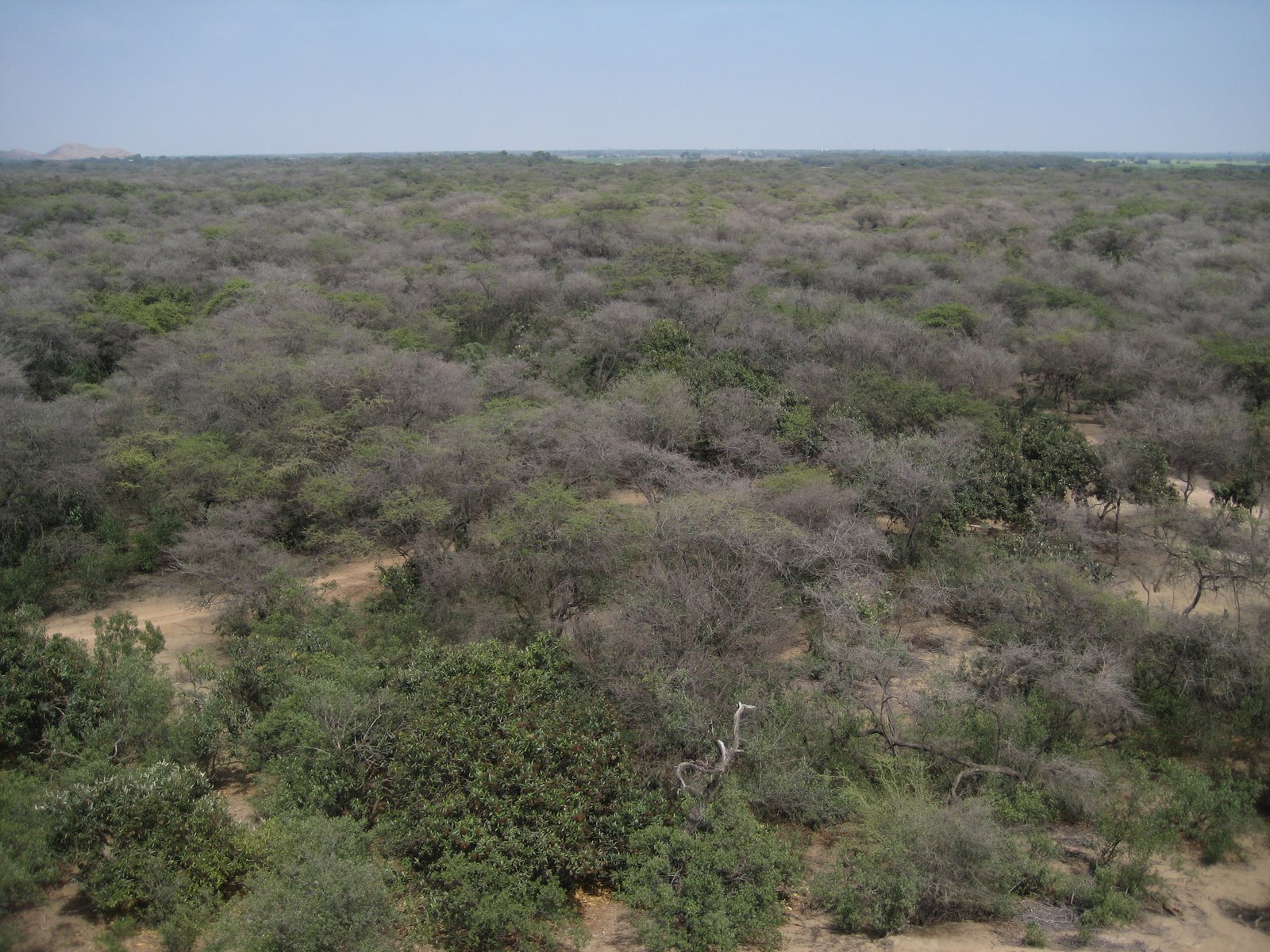
I arrived at my new site, El Sauce, on Friday afternoon to find that, indeed, there are no willows in El Sauce. However, from my backyard there is a clear view up into the cloud forest of Santa Barbara National Park. The scattered houses of El Sauce dot the hillside along the edge of the nuclear zone of the park, with farm plots creeping upwards, creating a clearly discernable line between the remaining cloud forest and development as El Sauce knows it.
My new house is nice by my standards, with an indoor bathroom, tile floors, windows with screens, couches and no holes in the walls. There are also no rats running across the rafters like there were in my first house in Huaca Rivera. It is certainly one of the nicer homes in town. My bedroom is, however, roughly the size of my laundry room in the States, with less storage space and entirely occupied by an enormous queen-sized bed.
Of course, my new home also includes a new host-family – two parents, two girls (10 and 5 years old) and a baby boy. Everyone in the family is very nice and the girls are particularly calm. The 5 year old does, however, have the particular habit of racing to finish her food before me every time we eat which is a little alarming because, while she does a fairly impressive job, it always ends in a few disconcerting gasps for air.
Honestly, this family is pretty hands-off and understanding in terms of allowing me to maintain a certain level of independence. After having lived with about 8 different host-families, I’ve learned how to make myself at home pretty much instantly. Nonetheless, it is never really that comfortable. Once again I’ve reverted to feeling a bit like a child. For example, I now have shiny pink toenails complete with floral decorations courtesy of my host-mom. I’ve never had decorations on my toenails, but she insisted.
Also, the other day I wanted to go for a run so I asked my host-mother where exactly I could run. She informed me that I could either run up or down the hill, with the condition that if I ran down the hill I could only run as far as a certain concrete fence. I opted to run down the hill, assuming that the fence would be a reasonable distance away. Well, as soon as I left my house I could already see the fence and I arrived at said fence approximately 30 seconds later, probably less. So, I turned around to run up the hill which was around a curve and, thus, not readily visible. The top of the hill was roughly 15 seconds from my house. It was quite the run.
Amazingly, my host-mom gave me the option of preparing my own breakfast. Nonetheless, when I asked to borrow a pan to fry an egg she took it upon herself to add about ½ cup of oil. I actually tried to get her to take some out and she simply replied that the extra oil would remain in the pan once the egg was cooked. Then she cooked the egg while spooning copious amounts of the extra oil on top of the egg. Indeed, some oil remained in the pan but at least half was absorbed and, therefore, ingested.
Also, along with living with a host-family comes the usual slew of awkward questions: Do you believe in God?, Why don’t you eat meat?, You know that our meat is healthier?, Why won’t you at least try this endangered armadillo?, How much did that box of tea cost? Of course, even if that box of tea cost $6.00, once converted to Lempiras, it might as well have cost you $100 because that’s what it seems like to them.
In terms of work, I’m back to square one, with nothing to do. Hopefully I don’t go crazy because I’m not sure I can handle the lack of productivity again. I saw my counterpart at the Sunday church service and asked when the next water board meeting would be. Since he is on the board and my counterpart for precisely that reason, I assumed it were logical that I would attend. He was like, “Oh, I doubt you’d want to go.” As I suspected I would be, I’m concerned that this site has not been developed at all in terms of PC site development.
Friday, February 12, 2010

Monday, February 1, 2010
Transitions
My one month break at home came and went in a blur. After over two years away, one month at home was kind of a tease. Once again I boarded a plane and left the States for the Peace Corps, although this time for a one-year extension in Honduras. I was less than thrilled that the Peace Corps insisted on booking my flight at 5:30 AM. I was in Honduras by noon.
The Protected Areas Management program specialist picked me up at the airport and bought me a baleada, a flour tortilla filled with refried beans, cheese, egg and drizzled with mantequilla, a sauce similar to sour cream. She told me there wasn't anything more typical of Honduran food than the baleada. I liked it. Less than a week later I realized that baleadas or some version there of are pretty much all that Hondurans eat. Sometimes they mix it up with corn tortillas.
Pretty much upon landing the PC staff whisked me away to the office to commence my own personal training. Admittedly, the one-on-one training was kind of intense compared to my experience in Peru. Doing participatory activities when you are the sole participant is not exactly a ball of fun. Also, going it alone was far more difficult than I imagined it would be. On day two, I cried in the office bathroom.
After a week in the office, I was sent off to shadow a fellow environment volunteer for 10 days. Her site is located in the buffer zone near the Parque Nacional Azul Meámbar and has beautiful views of Lago Yojoa, the largest natural lake in Honduras. We passed the time visiting various places and organizations in the area. On my second day there we actually made the trip to La Esperanza, a larger town about 1.5 hours away, for the annual potato festival. It struck me as being a bit ironic since I just came from Peru, the home of the potato.
We also visited the lake which is really beautiful and surrounded by hills and two national parks - Parque Nacional Azul Meámbar and Parque Nacional Santa Barbara. Through a connection of the volunteer's we also went to visit a nearby lead and zinc mine. We ended up meeting the owner (a Canadian) and the second-in-command (a Chilean), who met each other in Peru at a mine in Ancash. We were invited up into the lounge of the mine's admin staff and I felt like I had stepped back into the 1950s -- picture foreign engineers with their fancy wives drinking wine and cocktails. Of course, the people who actually work the mine live below in shacks while the admin staff lives in a gated community with a pool and hot water and the owner makes $55,000 a month. The mine does do a lot of social work and the workers are well compensated compared to most Hondurans; however, there is something very telling about the blatant disparity in wealth.
On the weekend we went to visit a Honduran friend of the volunteer's who lives in San Pedro Sula, the largest city in Honduras. Hot and crowded, there isn't much to recommend about San Pedro. We paid a requisite visit to City Mall, a super fancy mall which looks silly in juxtaposition to the urban squalor of San Pedro. San Pedro and the highway leading to San Pedro from the south are among the most dangerous areas of Honduras due to intense gang activity related to the cocaine trade. Nonetheless, the search for opportunity and jobs brings people from all over the country.
-------
Unexpectedly, the transition from Peru to Honduras has been really hard for me. I know no one. The culture is very different while still maintaining certain similarities, which perhaps makes it more disorienting. The official language is still Spanish but very different nonetheless. The language here is more formal which makes me uncomfortable--they even use the formal Usted form here with children. In Peru I obtained a certain comfort level which is now gone. When it comes down to it, I'm homesick. But I'm homesick for Peru. I'm sad that I'm not there. I'm sad that I won't live there again. I miss it. I miss the people, the food, the weather, the market, the bus rides, the moto-taxis. I miss it all. I even miss Lima which is saying something.
During the first two weeks, I found myself constantly comparing Honduras to Peru. It was even difficult to find beauty in the verdant, rolling hills of Honduras because I kept comparing them to the stark peaks of the Andes. Finally, however, I realized that I could cherish and miss Peru without directly comparing it to Honduras. Personally I think the transition hit me hard because I felt guilty about moving on so quickly, about leaving Peru behind and going someplace new, about leaving. When I think about my little host-brother it still brings tears to my eyes, but there is no way to tell him that.
I'm finally starting to feel a little more settled. Taking the bus back to my host-family's house no longer makes me extremely nervous. Also, they finally gave me information about my new site so I can at least picture where I'll be for the next year. My new site is a small, mountainside community of 350 people called El Sauce (Willow). It's located in the buffer zone of the Parque Nacional Santa Bárbara, a national park which harbors cloud forests, subtropical wet forests and highland pine forests. It is also home to Santa Barbara Mountain, which at 9,000 ft. is the second highest mountain in Honduras and, also, the only high-altitude limestone mountain in Central America. The community has expressed interest in the following areas: latrines, environmental education, chicken coops, eco-tourism and household gardens.
-------
If you are interested in finding my site on a map, here's how: Look first for Lago Yojoa, the big lake between Tegucigalpa and San Pedro Sula. The National Park Santa Barbara is located on the NW side of the lake, and my site is on the northern side of the park. On a good map you should be able to find a town called San Luis Planes which is my district capital and fairly close to my site. If you can locate Peña Blanca and the town of Santa Barbara, San Luis Planes is pretty much directly in the middle of those two towns.
Sunday, December 27, 2009
Ignorance is Bliss
After living in Peru for over two years, I arrived home during the first week of December. Leaving my site was the hardest thing I've ever had to do. I'm not complaining; I'm just stating the facts. People cried. I cried. My host-brothers actually sobbed. A dozen women and girls accompanied me out of my site on moto-taxis, blowing whistles and horns the entire way. The whistles were a bit much but I appreciated the gesture. Leaving was obviously something I had to do but that didn't make it any easier.
Then I got home and lived for two weeks as an anti-social being, holed up in my parents' house with random forays into society to run errands with my family. Nothing about the U.S. overwhelmed me as much as one might suppose. I expected the shopping malls. I expected the SUVs. I honestly was feeling a bit guilty about not experiencing the typical effects of reverse culture shock. I was starting to feel like maybe I was just forgetting Peru too quickly.
Then, I actually left my house and started interacting with other people. Little did I know that I had just been living in ignorant bliss. Apparently, the vast majority of the privileged U.S. population is living in ignorant bliss of another kind because they don't truly seem to care about anything going on outside of their own lives and certainly nothing going on outside of their own country. Hence, what follows is a bitter parody of the SNL segment "Really?" which, unlike the SNL version, has no intended humour.
Really, you think I want to listen to you talk about how a meal is just so much nicer with a fine, pressed damask napkin?
Really, you're really going to check Facebook on your portable phone machine in the middle of our conversation? Really?
Really, you bought your young children Motorola Droids for Christmas? I don't even know what those are. Really.
You seriously think you need to replace your HUGE television with an even more GINORMOUS television? Really?
You're actually going to talk about yourself for, oh, 3 hours and not even bother to ask how I've been? Well, that REALLY happened.
You really think that the way you live doesn't have implications? Really?! You don't think that just maybe you really aren't entitled to everything you have?
REALLY?!
Thursday, December 17, 2009
After two years in Peru, I...
...Finally understood a joke about rice preparation and actually thought it was funny.
...Am still constantly baffled by Peruvian medical remedies. Suffering from a wound or perhaps the common cold? Try kerosene. I hear it works wonders.
...Continue to laugh in people's faces at inappropriate moments because I'm positive that they are joking and, go figure, they're not. Case in point: I was recently told by my host-brother, who is 15, that his feet grew so much because he wore sandals and watered his feet. "Just like plants," he said.
...Point out Gringos as if I were not one myself.
...Am completely unfazed by any invasion of my personal space.
...Have kind of, maybe, gotten used to seeing my primary school students at parties.
...See no problem with referring to someone as Chino.
...Still don't understand why many Peruvians are called Chino when they have no characteristics meriting the nickname whatsoever.
...Love chicha.
...Would rather drink about anything other than lukewarm Peruvian beer.
...Feel like my Spanish language level may have advanced from that of a 6 year-old to that of a 6.5 year old.
...Am certain that my English language level digressed.
...Feel like an 8 year-old because I've reverted to wearing clothes that were picked out by my mother and eating whatever my Peruvian host-mother puts in front of me.
...Feel a little sad that I won't see my younger host-brother grow up.
...Am looking forward to being able to eat what I want to eat, when I want to eat it.
...Do not regret not being able to eat what I wanted to eat, when I wanted to eat it for the past two years.
Sunday, October 25, 2009
That would be mine.
I've broken/lost 5 pairs of sunglasses while in Peru; hence, with only a month left to go, I decided that it was not worthwhile to replace my current pair which have a cracked frame. Besides obviously being tacky, the lens also randomly pops out, leading to some rather awkward situations. Recently, my lens suddenly popped out just as an elderly man was climbing onto the moto-taxi next to me. My lens landed precisely where he was about to sit down which I realized at the last second. In an attempt to recover the lens my hand shot out and, of course, both the lens and my hand ended up under the man's butt. An alarmed expression which said, "Is that really her hand touching my butt?!" crossed his face before I could explain the situation. Luckily, the lens was unharmed and the man laughed. I popped the lens back into place and we were on our way.
The One and Only
Two years have gone by. The important part of that statement is not that two years have gone by since I arrived but, rather, that two years have passed since the previous volunteer left. Two years after Rob departed he is still beloved by all. Not only do they remember him fondly but he keeps coming back to visit. In May, he visited and happened to show up at an ECO event that I was also attending. Of course, the announcer introduced Rob like this: "And now, lets give a big welcome to ROOBBEERT ELLIOT!!!" He proceeded to introduce me and a random French girl as their "other friends from other countries." I had to laugh. I wasn't actually surprised because I never work with ECO and Rob did, but still, the disparity was kind of ridiculous.
Now, the Peace Corps is going to send another volunteer to Rob's site (I live in a neighboring community). The local rumor is that Robert is actually coming back to live. I suppose they'll be in for a surprise when the new volunteer arrives and looks nothing like Rob.
Ingleesh
In many Latin American countries, certain English words have been absorbed into the local vernacular. Obviously, English words are commonly used for items which have been introduced from abroad, such as technology -- USB=flash, mouse=mouse, laptop=laptop, to click=hacer click. However, other words that have been borrowed seem somewhat random. In Peru, for example, a toilet is called a "water." It is difficult to predict when locals will opt to maintain the English word for a particular object. One time I spent a good 15 minutes trying to buy masking tape to discover that it is called, go figure, cinta masking.
English is also used in some rather unexpected ways, often in advertising or as a status symbol. For example, the other day I encountered an advertisement for the "one-piece legend" toilet. The entire sign was in Spanish except for the words one-piece legend. First of all, what kind of toilet deserves the name one-piece legend. Also, since most Peruvians can't even understand those words, to them it is actually the "a bunch of gibberish" toilet.
Also, some words maintain the proper English pronunciation while others acquire a Spanish twist. Consider the word huachiman, a botched version of watchman which is pronounced watchymon. Or brother, used as slang for friend and pronounced bro-der. For the English speaker, this unpredictable use of English can be confusing. Once, at Starbucks, I tried to order a "moofeen" only to have the girl behind the counter confirm my order of one muffin. Then Susan, confused because at Starbucks muffins were actually called muffins, attempted to order a cookie and received baffled looks because they had no idea what she was talking about. My friend Michelle once called a hostel called Hobo Hideout and, of course, pronounced it in Spanish (Hobo He-dow-te). The receptionist was like, "Um, Hobo Hideout?" As a general rule, it is safe to assume that, when using English in Peru, you, the English speaker, will always be wrong.
- - - - - - -
The other day a Peruvian doctor was practicing her English with Susan and I when she reacted to something Susan said with "Oh baby!" I don't even remember what Susan had said but it certainly didn't merit an "Oh baby!"
Subscribe to:
Posts (Atom)