Yesterday, while making compost with the female park guards, I ended up in a 1 m³ hole in the ground with a tarantula the size of my fist and, miraculously, I didn’t freak out. I calmly scooped it up with my shovel and removed it from the hole, at which point the women quickly smashed it. Given my previous sentiments towards the entire arachnid family, barring daddy long-legs, I was pretty impressed with myself. At one point in my life, anything with eight legs over the size of a dime was too much for me to handle with any kind of reasonable behavior. However, after being lectured by the women about how poisonous they are, and about how I was lucky it hadn’t attached itself to my leg, I promptly removed myself from the hole.
-------
Speaking of compost, I’ve been making a lot of it lately. As the price of urea, a nitrogen fertilizer, has skyrocketed in the past year due to rising petroleum prices, people are starting to take an interest in organic alternatives. In the last month I’ve given several compost talks. Susan and I even got together to give a joint lesson in Pacora. We posted signs all over town and in our communities. In the end, there were over 20 people there, most of them male farmers from the district. I was surprised that so many interested people showed up. I’m sure they were surprised to find that the event was being hosted by two young girls from the U.S. Some of them had ridiculously specific questions like, “Exactly how many kilos of compost should I apply to one hectare if I am going to plant yellow corn?” In general, I was really impressed with how interactive the participants were and I think they might actually apply what they learned. In the upcoming weeks we are going to teach them how to make biol, a liquid fertilizer, and humus.
-------
The presupesto participativo is finally really over. Knock on wood. I don’t actually believe it. They say that next year I will have S/.5000 to construct improved cooking stoves in Huaca Rivera. That’s half of what they allotted me the first time, but just about perfect for the number of people that are signed up, exactly 25. I had a meeting with the participants to let them know that the project was approved and that they should begin making the necessary adobe. One woman complained about not wanting to make the adobe and I was relieved when the rest of the people didn’t take her side.
-------
On Saturday morning, I heard a familiar voice coming from the next room, my old host-sister from Lima. Apparently, she’s back, for good. No one told me she was coming back. It really threw me for a loop because I knew my boss was coming on Monday to talk with my host-mother about me changing houses. Well, he did come, but by the time he got here I was even more thoroughly confused about whether or not I should move. For now I’ve decided to stay in my current house for a couple of weeks to see how it goes with my host-sister back. But I don’t know if, in the long run, I will be happy with that decision.
Thursday, October 30, 2008

Friday, October 24, 2008
La fiesta de San Francisco
The parents have now come and gone. Despite the fact that I did not go out of my way to make them comfortable, they handled every situation with grace and thoughtfulness for the culture. They never once complained. Well, my Dad did look pretty irritated when he, the largest of all the roughly 23 people crammed into a combi the size of an Astro van, was forced to sit, not on a seat like the rest of us, but on a TINY stool less than a foot wide in all directions. They braved the latrine, the chicha, the public transportation system, and, most impressively, my site during its one-and-only annual festival.
As soon as we arrived in my site on Saturday morning—day one of my community’s celebration of San Francisco, the patron saint—I knew my parents would be in for an unusual experience of my site. While it was nothing close to the reality of everyday life, I do feel like it provided them with an extreme, condensed version of my experience in Perú, minus the tranquility which admittedly dominates most of the time. The festival was entertaining, hilarious and absurd, enjoyable, full of generosity and drunken people, unreasonably loud, and involved plenty of Catholic ritual and beer.
I unnecessarily explained to my parents that, indeed, it was not normal to have a band repeatedly march by my house. We ended up following the same band to the church where we attended the mass. My mom and I were asked to walk a banner up the aisle in front of the packed congregation. Thankfully the priest only asked my mom one question, “¿Cuál es tu nombre?” and it couldn’t have been clearer. Following the mass we were invited to stay and eat with the donors, volunteers, and organizers of the event. I ended up sitting separately from my parents, which created a bit of a difficult situation, because, regardless of how many times I told them, people just didn’t seem to understand that they didn’t understand Spanish.
In the afternoon, we watched a dance competition and a soccer match, both of which ended in fights. The dance competition ended with a discontent crowd and a pissed-off judge who decided to speak her mind in a not-so-friendly way. The soccer game literally ended in a brawl.
By the evening we were all fairly drowsy so we settled down in front of my house with the rest of my family to watch the passing activity. My host-mom mentioned something about watching the image of the saint pass by later in a procession so I told her we would like to see it also. Well, I should have known that watching the saint pass by would turn into participating in the procession along with everyone else from my town. The total distance we covered was approximately the size of four city blocks but, as we walked it at a pace slower than what I previously thought possible, it took more than two hours to complete.
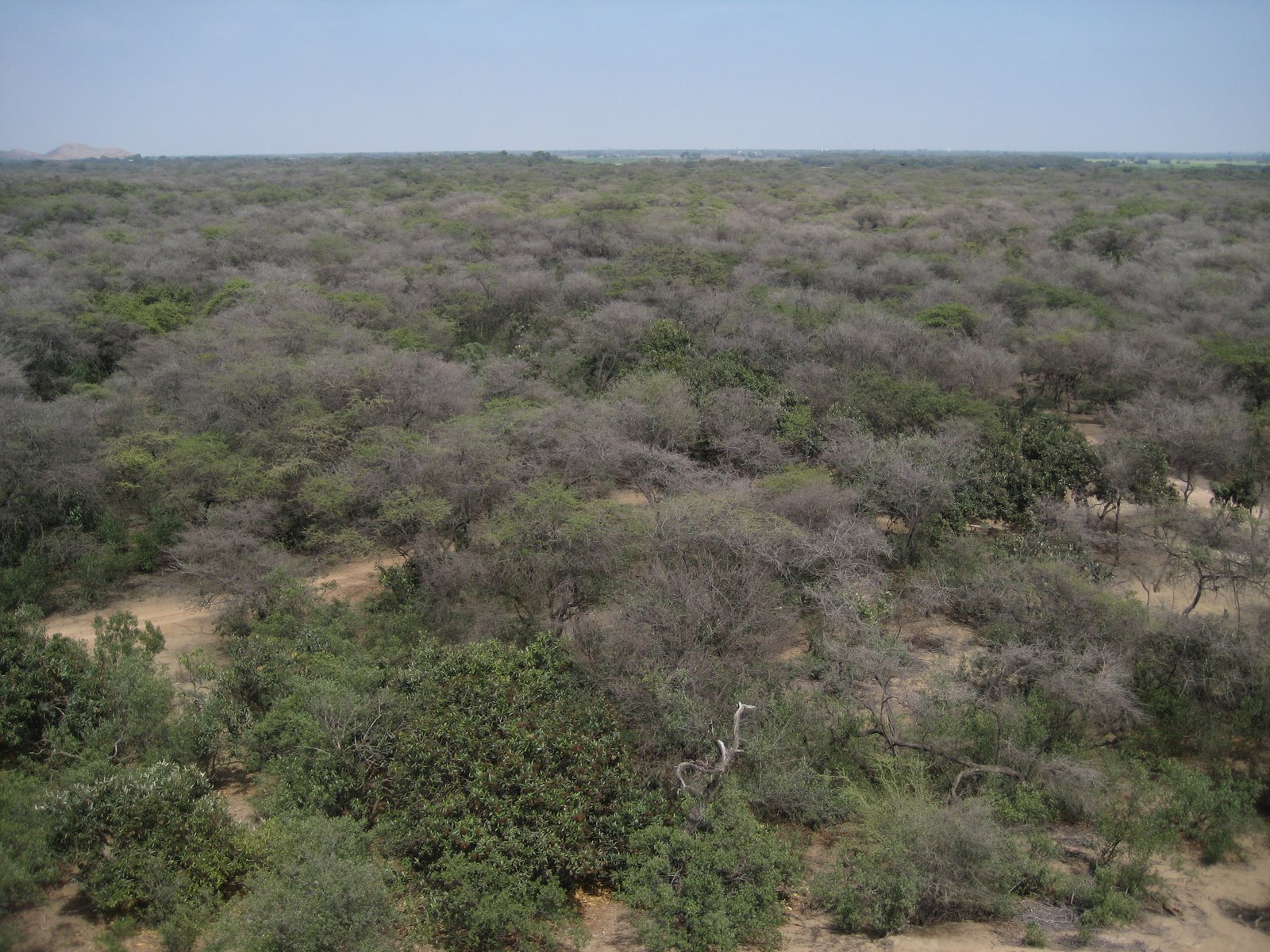
Day two consisted of more of the same. We awoke to fireworks blasting and the blaring marching band. In the morning we did manage to escape for a lengthy walk in the dry forest reserve bordering my community. We walked until we reached the pyramids from the pre-Incan Sicán culture which are currently under excavation. Even though it was a Sunday we got a tour from the guard. As expected he knew Rob, the volunteer I replaced.
In the afternoon we got to spend time with one of my closer friends from site and her family. “El Chino,” another favorite and my friend’s uncle, was passed out in the corner when we arrived. Part way through our visit he awoke; his awakening was classic. To start with he had been passed out with his head down and covered by a wide-brimmed straw hat. As he came to he slowly and painfully opened each eye, one at a time and with much squinting and great effort. As he turned his head in my direction he noticed my mother first. By the time he saw me he was fully alert and in the process of whipping off his hat and barreling over to greet us. Fully alert is probably an inaccurate description of his state since he conveyed his entire greeting to my mother with over-zealous hand movements. The greeting consisted of pounding his chest with both hands and making some kind of Italianesque kissing motion. My poor dad was sitting by him and had to deal with the hand movements for a good hour. The guy was oblivious to the fact that my Dad would never understand his Spanish. The funny thing was that my dad kept turning to me to translate and every time the guy had said the same thing, that I am well loved here. At one point the guy turned to talk to me and just pointed to my dad and then thrust his hand above his head indicating that my dad was very tall. My mom was seated by “La Gorda” who kept calling my dad Gordo instead of Gordon. No one could figure out my dad’s name.
Probably my favorite incident from the entire 48 hours occurred as we arrived back at my house. My host-mom’s over-sixty brother was there with a friend and an empty crate of beer which they had polished off in our absence. The friend, a talker, started into a rambling and haphazard conversation with me and my parents. At one point he asked their ages which for some reason piqued his interest. This led straight into the question for my father which was “Do you still blow?” I, befuddled and translating directly, turned to my parents and said with a really perplexed look on my face, “He just said, “Do you still blow???” Then, he unfortunately elaborated, accompanying his question, “Yeah, does he still blow?” with painfully obvious jerking motions. The other one joined in, completely interested in the response, “Does he still make love to your mother?” Why I translated that statement is probably the better question. Neither one of the men seemed to think that, just maybe, this was an inappropriate topic.
Tuesday, October 7, 2008
Los Padres
For the last week I've been with my actual parents from the U.S. They arrived in Lima on the 29th and since then I've been showing them the more realisitic side of life in Peru. We started off in Miraflores, the not-so-realistic side of Peru. An affluent, costal neighborhood of Lima, Miraflores is packed with tourists, hotels, and expensive restaurants. I almost went into shock when I emerged from the taxi in Miraflores to see two separate people walking healthy dogs on leashes!
From Lima we continued up the coast to Trujillo, where we stayed in the coastal town of Huanchaco and visited Chan Chan and Huaca de la Luna (pre-Incan ruins). My parents were highly impressed by the $4 breakfast we purchased which included organic coffee and cream, a fruit salad with natural yogurt and honey, fresh juice, a pancake, and an ocean view. Of course a $4 breakfast is ridiculously expensive when you are thinking in soles, the local currency, but it was delicious.
The last couple of days we spent in my site, which happened to conincide with my community´s annual festival. Not surprisingly, I have much more to say about that but it deserves a separate entry.
Currently we are killing time in Chiclayo, waiting for more information on an indigenous strike which, as of last night, was blocking the road to Chachapoyas, our next destination. Hopefully the strike lifts and we can continue on our way. If not, it looks as if we will have to rethink our plans.
Thursday, September 25, 2008
La Pan-Americana Antigua
Reminiscent of an aging highway in the states, the old Pan-American feels a bit used, a bit dusty. Pacora, the closest town to my community, is cut by it, as are all of the towns out in my direction. Once the major road between Piura and Chiclayo, but no longer, it is still highly trafficked. As opposed to a highway in the States, personal vehicles contribute to a small amount of the traffic. The cars you’ll encounter on the Pan-American are primarily dedicated to public transport and to the transport of goods.
In the category of public transport you’ll see moto-taxis, estations (station wagon taxis), ticos (random sketchy car taxis), combis (van taxis), and double-decker tourist buses. Of those, the scariest to watch are probably the tourist buses. They kind of wobble down the road at high speeds, tilting from side to side. The most dangerous to ride in are probably the combis. I’ve yet to meet a combi driver whose driving skills I completely trust. And I’ve never been in a combi with seatbelts for anyone but the driver and one of the front seat passengers. Sometimes the seatbelt isn’t even real but they require you to wear it anyway so they won’t get in trouble with the law. I always refuse, telling them it’s their own fault if they get stopped. It’s one of the only things I ever get into arguments about. They always give in.
More entertaining are the vehicles used for the movement of goods. These range from donkey carts to semis. However, the most colorful are what I refer to as mango trucks because during mango season their primary task is to transport mangos from field to market. These are like no small-semi you’ve ever seen. They are always painted in obnoxiously bright colors and on the back they usually are adorned with a larger-than-life religious image, often an agonized and dying Jesus. One of my goals while in Perú is to capture a picture of one of these mango trucks that is transporting corn. For some reason, when they load them with corn they just go crazy and they don’t stop loading until the corn is piled to a height nearly double that of the truck and protruding from the back.
Rules of the road? At first glance, it appears that there really aren’t any. And when it comes to obeying the official laws I’d say that first glance is accurate. I have personally witnessed the hand-signal language of combi drivers which is used to alert fellow divers to temporarily obey the law when cops are present. That probably has something do with the alarming number or crosses and little chapels dotting the side of the road commemorating people who have died in accidents. Otherwise it is just controlled chaos. While the Pan-American appears to be only a two lane road, it can at times have up to four lanes. Passing is not reserved for when no one is approaching in the other lane. Rather, it is expected that on-coming traffic will take note and move on over to the shoulder.
Thursday, September 18, 2008
¡Que viva el santo!
On Monday I turned 24. I wasn’t sure if anyone would even know, so I was prepared to pass the day like any other. However, a group of somewhat random women ended up organizing a small party which consisted of cake, papa a la huancaína, wine that tasted slightly better than cough syrup, a cocktail, some singing and plenty of somewhat forced and awkward dancing. I had to dance the Marinera with every single person in attendance even though it’s pretty complicated and none of them could dance it either. They also serenaded me which was pretty hilarious in itself. My counter-part, who out of nowhere busted out a perfect tenor voice, sang the main part, while the rest of them, all with horrible voices, sang the chorus. I tried to thank them, but I couldn’t really figure out a way to truly convey just how much I appreciated it. Considering how little they have, and that they rarely buy cakes for their own birthday parties, it was extremely generous.
Back at home I invited my host-mother to some cake. Earlier I had gone to the house to invite her to the party. She actually had no idea it was my birthday and was a bit surprised. However, she said nothing like, “Oh my goodness! I had no idea. Happy birthday!” No, she said, “I already ate lunch,” and didn’t come to the party. Still, as I offered her the cake I assumed that we were on good terms. Then came a diatribe about how she was mad at me for having my birthday party at another person’s house. She refused the cake, telling me that I should have told her it was my birthday, because she would have bought me a cake. Maybe it was my fault, but I would have felt awkward telling her “Tomorrow’s my birthday; maybe you should throw me a party.” I tried in vain to explain that I had not actually chosen to celebrate my birthday in the house of another and that I wouldn’t have even celebrated if it hadn’t been for those women. At this point she told me she didn’t believe me. She looked pissed. I got upset, put the cake down, thanked her for wishing me a happy birthday and walked away. She followed me into my room, continuing to explain that she was highly offended. I mean, what would my real mother say when she found out that I had not had my party in my own house?!
I started looking for a new house/family. It’s really not that easy and kind of over-whelming. There are only 50 families in my town and at least half of them are related to my host-mom, if not more. Furthermore, most of them do not have any extra rooms. It´s also far more difficult to chose a host-family now that I know so many of the habits and histories of the families. I approached one señora who previously offered me a room, but she told me that she didn´t want any problems with my current host-mom. By the time she started listing other families I could live with, I had pretty much gotten the hint.
-------
As far as birthday celebrations are concerned, many volunteers dislike them. In the Peruvian campo, they are usually family affairs and consist of a circle of people drinking, usually for many hours. I, however, usually find them quite entertaining. The last one I went to was already in full swing by the time I got there. It was me and eight other people. I got stuck between two very campo men who had already been drinking for awhile. Most of the time they were both talking to me at the same time. One of them kept bursting into song. He sang with such force and frequency that it was difficult for anyone else to carry on a conversation. When the food came out and I didn´t eat (because they had just served me a special plate of food), he insisted that I at least consume the spoonful that he was waving around in my face. I told him I couldn´t eat the big hunk of meat on it so he picked it out with his fingers, in the process knocking beans all over my lap. The man on the other side of me was delighted when I told him that it is indeed legal for me to marry a Peruvian. He proceeded to warn me about Peruvian males, and told me that it was okay for me to date them, but that I should never remove my bra. He got stuck on this subject and told me at least four more times before he decided to share his advice with the rest of the group. I left around the time someone was asking me to pronounce my last name in Peruvian.
Saturday, September 6, 2008
Kidneys and Chinos
At least in the rural parts of coastal Peru, a day rarely passes without someone mentioning that they are suffering from kidney pain. When I first arrived I was perplexed by how many people were afflicted by this strange and ubiquitous “dolor de riñones.” I mean, kidney pain sounds like it should be taken pretty seriously. Eventually I figured out that most people here confuse back pain with kidney pain and any mention of kidney pain became a little less alarming. However, the other day I was especially amused when one woman, complaining of extreme shoulder pain, was immediately diagnosed by a fellow woman as suffering from a kidney ailment. She said, perfectly serious, “Oh, that’s gotta be your kidneys,” followed by a chorus of “Yep, definitely the kidneys,” from the other six women standing in the circle around her. Unanimously they agreed that she should go to the health post for a series of shots that would cure her kidney ailment. I wasn’t sure what I could say at the moment without butting directly in the head with the kidney myth, so I waited awhile until the woman was a bit separated from the group. I kind of sidled up to her furtively, fearful of being reproached by the rest of the women, and whispered, “It might not be your kidneys…it could be your muscle. I think you should try icing it.” Of course, she went to the health post.
The Beijing Olympics highlighted another custom—the practice of calling all slightly Asian looking people “Chino.” The country of origin really is of no importance. Even many Peruvians have the nickname. Thus, just imagine the opening ceremony. There were the Japanese Chinos, the Chinese Chinos, the Korean Chinos, etc. During one gymnastics event, the Peruvian announcer was highly perplexed by the presence of an Asian-American athlete. His commentary went something like this: “And now we have a Chino…wait, it appears that he’s not a Chino…he’s American…but still a Chino?!…Well, he likes Chinese food!”
-------
I bought an English shirt which looks roughly like this:
Ever mode honey girls
they’re been together
EVERY
UGIZ
EARTH
Ever mode honey girls
they’re been together
EVERY
UGIZ
EARTH
And Luck
GOOD
Seriously? Ugiz?!
-------
GOOD
Seriously? Ugiz?!
-------
The neighbors named their new dog Gringa. Should I be offended? I mean, I’ve never really seen an ugly puppy but this one would be right up there with the best of them. I believe they got the idea from the many patches of white skin which have appeared through its brown fur due to excessive fleas.
-------
Municipality update: So I went there for the millionth time at least and was told, yet again, that the Presupuesto Participativo had been postponed. I'm still waiting to figure out if they are going to fund my improved cooking stove project. Then, while talking with the mayor about waste management, he suggested that we continue the subject over pizza...and then recommended a nice hotel...which we could stay in. How nice.
Monday, September 1, 2008
Bwuuuu
There is a noise they make here—kind of like a high-pitched bwuuuu—that would perfectly describe how I feel about the past week. You’ll probably notice it the next time you see me, because I can’t seem to converse without it now. Its meaning is flexible but tends to convey something along the lines of “Good God!” In this case, if I used it you would understand it as “Oh my God, you don’t even know!” But that was last week and, after a bout of crying in the municipality, I’m feeling much better. Yes, I cried in the local municipality. I’m sure they think I’m emotionally unbalanced.
I cried not because I was actually that upset that I was being denied funds through the Presupuesto participativo, but because I was repeatedly being told that my entire concept of development, whatever that is, was just plain naïve, and that the people will never change. The idealist in me cried. The realist in me was discouraged, because realistically I don’t believe positive sustainable change is possible without a good dose of idealism.
I left emotionally drained and laughed in the park with Susan harder than I have in a long time. I think it was somewhat of a turning point. If I actually wish to see some kind of shift in mentality among the people in my community I have to start looking at my work more like a job. No one really takes me very seriously and maybe I haven’t given them enough of a reason to.
Up until this point I think I have been walking on eggshells, tripping over myself just to avoid offending anyone because I live here and because I’m supposed to integrate. But I’ve got to be more honest with people. Not everything is perfect here. Everyone burns their trash. No one recycles. The development committee is defunct. People are perfectly capable of telling me that they have no money for an improved cooking stove and then buying S/70 of beer. Of course it’s all normal, but that doesn’t mean it should be.
Subscribe to:
Posts (Atom)