The Move:
I believe that I had partially convinced myself that I would never actually change houses. However, in the first week of January, I finally did. With much help from Susan, I moved my things down the street to my new house. We walked all of my things from one house to the other, even my denser-than-lead mattress.
Everything went smoother than I had imagined it would. I was worried that the entire town would emerge to watch me move but the town was silent. Even the gossip I feared seems to have been held at bay. Having to, once again, tell the moto-taxi drivers where I live has really been the biggest nuisance. Not once have I regretted moving. My new family--a young family of four--probably talked to me more in the first day than my old host-family talked to me in an entire year.
The Vacation:
lima:
After more than a year my sister came to visit me from the States. I went to pick her up at the airport in Lima on Sunday night. Waiting at the airport in Lima is different than waiting at an airport in the States. A large crowd of anxious relatives mixed with hotel and tourist agency representatvies huddle around the exit waiting for flights to arrive. The hotel and tourist reps are all waving around signs on sticks with the names of the tourists they have come to collect. The awaiting family members exuberantly rush to meet loved ones who often now reside in another country.
My sister was taller than I remembered which might have had something to do with the new straight-leg jeans she was sporting. I regretted not having made one of those signs on a stick to grab her attention. She would have appreciated the humor.
The next day we went to visit my Lima host-family. On the way there, Kelly, unlike most tourists, actually saw the vast impoverished urban sprawl which comprises most of Lima. The visit was wonderful as always. Kelly was subjected to a viewing of the infinitely long and horribly edited video of the Santiago festival that I attended in July, the same video my parents got to watch. She also got to go on her first moto-taxi ride.
It was interesting to see how my Lima family has changed since they hosted me, especially since they have since hosted two other trainees. One notable difference is a marked improvement of the pronunciation of their dog's name, Snow. It actually sounds like English now. Also, my host-mom, who used to fret and think I was crazy for running all the time, told us, in all seriousness, how she had tried, in vain, to convince the last two trainees that they needed to excercise.
I managed to leave my footprint in the newly poured concrete step in front of the house. I don't know how I didn't realize that I was supposed to step over it. My host-sister, Rosa, stopped before going over it and asked me to go first because she wasn't sure how to avoid the step. I, oblivious, didn't understand why she was so perplexed and stepped directly onto the wet concrete. A few minutes later, my host-Dad came in chuckling and said that it was just like the Hollywood Walk of Fame.
For dinner we had the traditional holiday meal of hot chocolate and panettone. Kelly made me look a little less stupid by biting directly into the paper wrapper of the panettone.
arequipa:
The next morning at 4:00 AM we had to go to the airport for our flight to Arequipa, a one hour flight which costs nearly the same price as the 14 hour bus ride. Stepping off the plane was the prefect antidote for sleep deprivation--snow capped mountains, crisp air and the early morning sun.
Arequipa is one of the southernmost provinces of Perú. The capitol city, also named Arequipa, is an impressive city, with abundant colonial architecture. It bears the nickname the "White City" due to old proclivity for building with the white volcanic stone common to the area. Arequipa houses numerous churches and monasteries. On our first afternoon in the city we visited the Monasterio de Santa Catalina, a rambling old convent which occupies an entire city block. We didn't leave without trying some of the famous desserts prepared by the current nuns.
Not one to mess around or to allow time for relaxing when on vacation, I scheduled a bus trip to Colca Canyon for 7 AM the next morning. Sometime before the end of her first 48 hours in Perú, Kelly became convinced that it was actually her 3rd day in country.
The bus ride to the canyon was a trip in itself. Much of the route passed through the Reserva Nacional Salinas y Aguada Blanca, an austere altiplano reserve which is home to vicuñas, llamas and alpacas. At its highest point the road reaches an elevation of 4800 meters.
We arrived at our destination, Chivay, a small town at the mouth of the canyon, mid-morning. After breakfast, we walked to some local hot springs. Somehow we ended up in the pool with all the other tourists. Roughly four guides attempted to get us back on their tour bus before they left, as they were convinced that we must have been on their tour. Either way is was very relaxing.
The following day we visited La Cruz del Cóndor, a short but picturesque busride away from Chivay. La Cruz is now a popular tourist stop on the Gringo Trail due to the Condor family which resides in that particular section of Colca Canyon. The Andean Condor is considered by many to be the world's largest flying bird, with a wingspan reaching up to 3 meters. Nonetheless, it may come in second to the Wandering Albatross. Kelly and I waited long enough to see the condors pass within several meters. The closest condor to pass us I actually watched through binoculars. The view clearly would have been better without them but I was too dense to figure that out. Rather I got a very good look at a blurred mass of black feathers. Binocular use has never been my forte.
Colca canyon provides a beautiful backdrop to the family of condors. At a depth of 3191 meters, Colca canyon is the second deepest known canyon in the world. The deepest known canyon, el Cañon del Cotahuasi, is actually also located in Arequipa, several hours to the north.
Our last day in Chivay we walked a little over an hour through the valley to the neighboring village of Corporaque. It was a beautiful walk through the bucolic countryside of the sierra, passed fields and terracing. The town itself was nestled among hills with a sweeping view of the valley and a tranquil plaza.
After another day in Arequipa, which we primarily devoted to walking around, we flew back to Lima. Being back in Miraflores was bizarre as always; it doesn't really fit with the rest of Perú with its fancy beachfront highrises and hotels. Kelly was a little sick which probably resulted from the fact that I encouraged her to eat salad and street food. I've clearly been here too long.
huaca rivera:
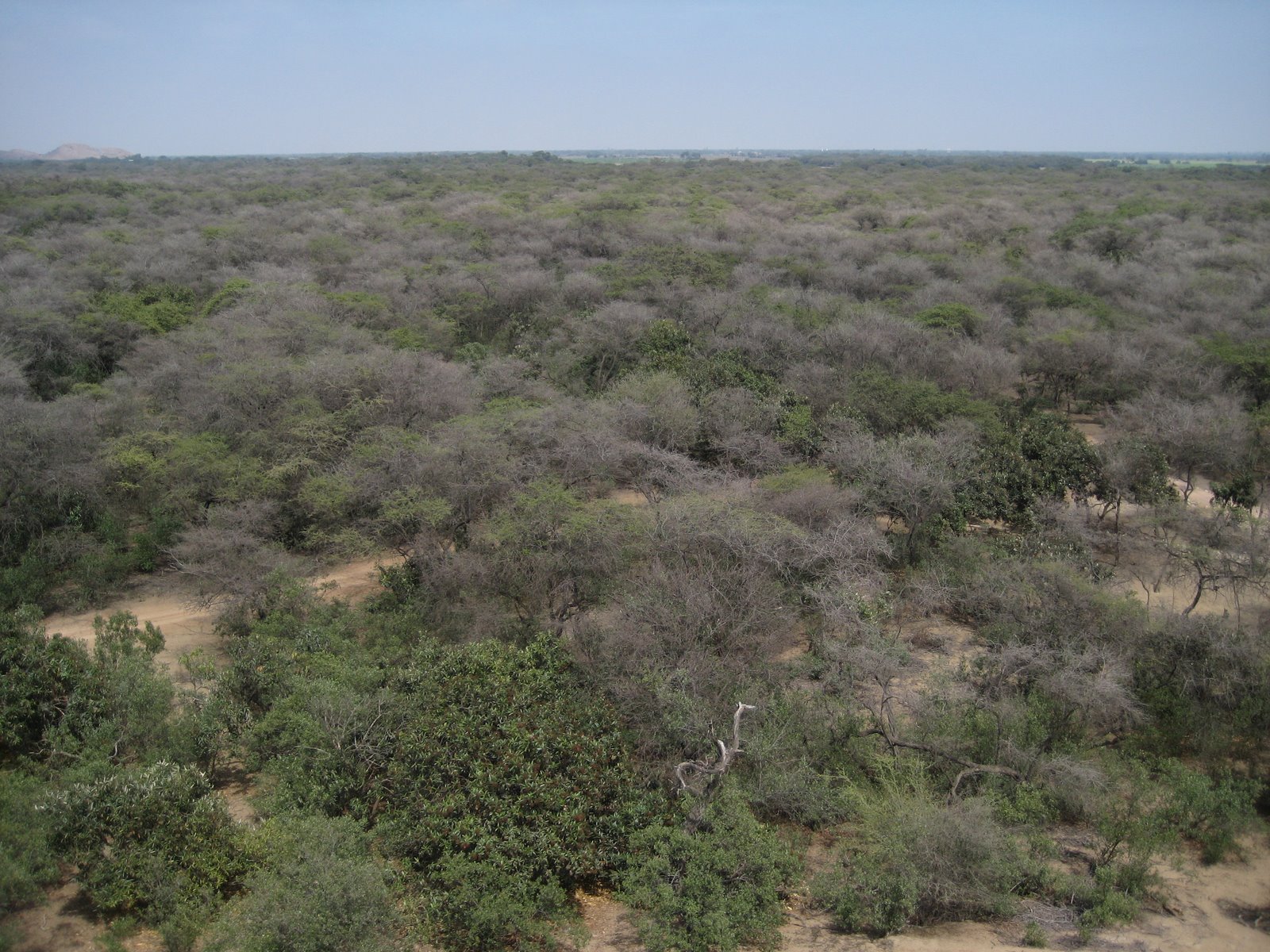
At the combi stop for Pacora in Chiclayo, we were greeted by the driver with, "So, you're headed back into the war zone...there's gonna be blood." Indeed, I took my sister back to my site on the eve of the removal of an invasion of people from a section of the Bosque de Pomac. Called a desalojo, or eviction, it was a government action to recuperate close to 1200 HA of the dry forest reserve which also houses archeological remains. The situation was rather complicated because around 200 families were implicated and, of those, some had lived there for 9 years. The government itself funded the construction of a health post and a school. And, in a country basically comprised of invasions it's difficult to pick and chose who to evict.
Anyway, nearly 2000 police came into the area for the desalojo. In the end, the "invaders" were heavily armed and 3 policemen were killed. Everyone in my site, was clearly preoccupied with the daily events. I decided against taking my sister for a walk in the woods. On the third day of the desalojo, my P.C. boss called to ask if I had heard what was going on, as if the people in my town would be completely oblivious, and told me that I should probably be careful.
Another visitor from the U.S., Susan Abraham, arrived in Pacora on Wednesday morning. Within an hour of her arrival she was serrenaded by the gerente of the municipality, aka Loco Sapote. We also went to visit the 83 year old store owner, whose birthday party I went to awhile back. As the mid-year festival of San Pablo was coming up, nearly the entire plaza was surrounded by restaurant booths and stands. Nonetheless, in front of our friend's store, there was, indeed, a 3 meter empty space, which she informed us that she had purchased in order to be able to watch the action uninhibited. She actually seemed annoyed that they would even consider blocking her view.
Susan and Kelly both adapted wonderfully to my site--except for a few issues with the outhouse and hard mattresses. They, both vegetarians, even ate fish. We played soccer a couple of times with the girls and transplanted some seedling in the tree nursery. My little host-brother, Patito, grew quite attached to them within the first day. By the time they left they were sad to go.
Since my sister is studying in Ecuador during the upcoming semester, her and Susan had to head north to Quito. I took them as far as Mancora, a popular beach in Piura. Amazingly, it was even hotter there than my site. We taught Susan how to dive under waves rather than simply being destroyed by them. However, while unsupervised she chose to practice in about one foot of water and ended up diving directly into the sand, scraping her forehead and smashing her nose in the process.
Saturday, January 31, 2009

Wednesday, December 31, 2008
Happy Birthday!?!
On Christmas Day I repeatedly sounded like an idiot because I kept greeting people with "Happy Birthday!" instead of "Merry Christmas!" It might have been funny had any of the people I greeted been named Jesus, as many males are here, but they were not.
In the morning, Susan and I walked back to my site, a process which took a little over an hour. Even early on, the day was already warm and sunny. Nearing my town I had a very Peace Corps moment when a women from my town stopped me to ask me if I knew who a stray sheep belonged to. She finally figured it out herself and sent me on my way with instructions to notify the owner. She also attempted to send me off with bottles of fresh chicha.
All around my community and probably in most other Peruvian communities, Christmas Day was dedicated to drinking. Passing by one house Susan and I were invited in for a copita (a little cup.) While the liquor we were served was poured from a wine bottle, I recognized immediately that it was not wine. With the first signs of a burning sensation in my throat I realized it was cañazo, or sugar cane alcohol. Before Susan poured her cup I warned her that, indeed, it was not wine but apparently that did not prepare her for cañazo, which she had not previously tasted. It evidently shocked her to the point of inducing a vomiting sensation.
Once Susan left, I paid a visit to my friend Sole and her family. At her house the drinking had begun at 8:00 PM the previous evening and was still going strong. Regardless, it was really pleasant to spend some time with them because they always treat me with respect and generosity. Also, it never fails to be entertaining. As always, the ancient grandfather began to cry when he started talking to me about his deceased wife. One by one or sometimes two at a time, the drunk uncles staggered from their seats to talk to me at an abnormally close range. One uncle decided to initiate an exhuberant round of cheers for Obama. Talk of Obama provoked a discussion of President Bush's plane (Air Force One.) They were absolutely convinced that the interior is covered in solid gold. They were also completely amazed by the salaries of the Air Force One Staff, purportedly $1,000 a month. I didn't tell them that a yearly salary of $12,000 would place someone below the poverty line.
-------
My family in the States called me in the afteroon to wish me a Merry Chrismas, which I expected. What I did not expect was to have my first realization that returning to the States may be a difficult adjustment for me. Except for a couple of packages and a heart-shaped jewelry box, for the second year in a row, I have not received any presents. And honestly, until both my Mom and my sister mentioned that they felt badly about not being able to give me any presents, I had never given the topic a second thought. I asked my sister, a very non-materialistic person for a United Statsian, what she got and quickly remembered just how integral presents are to Christmas in the U.S.
At this point I thought, "Yeah, not good. I'm going to get back to the States right before Christmas, probably a matter of days, and then I'm going to be bombarded with stuff. Definitely not good."
I'm quite positive I'll adjust to life back in the U.S. with relative ease, but I'm pretty sure I don't want to deal with all of the stuff. Unneccessary stuff. Stuff to sit around and stuff to take up excess space. Stuff which on some level proves a futile point, that we have enough money to buy it.
In the morning, Susan and I walked back to my site, a process which took a little over an hour. Even early on, the day was already warm and sunny. Nearing my town I had a very Peace Corps moment when a women from my town stopped me to ask me if I knew who a stray sheep belonged to. She finally figured it out herself and sent me on my way with instructions to notify the owner. She also attempted to send me off with bottles of fresh chicha.
All around my community and probably in most other Peruvian communities, Christmas Day was dedicated to drinking. Passing by one house Susan and I were invited in for a copita (a little cup.) While the liquor we were served was poured from a wine bottle, I recognized immediately that it was not wine. With the first signs of a burning sensation in my throat I realized it was cañazo, or sugar cane alcohol. Before Susan poured her cup I warned her that, indeed, it was not wine but apparently that did not prepare her for cañazo, which she had not previously tasted. It evidently shocked her to the point of inducing a vomiting sensation.
Once Susan left, I paid a visit to my friend Sole and her family. At her house the drinking had begun at 8:00 PM the previous evening and was still going strong. Regardless, it was really pleasant to spend some time with them because they always treat me with respect and generosity. Also, it never fails to be entertaining. As always, the ancient grandfather began to cry when he started talking to me about his deceased wife. One by one or sometimes two at a time, the drunk uncles staggered from their seats to talk to me at an abnormally close range. One uncle decided to initiate an exhuberant round of cheers for Obama. Talk of Obama provoked a discussion of President Bush's plane (Air Force One.) They were absolutely convinced that the interior is covered in solid gold. They were also completely amazed by the salaries of the Air Force One Staff, purportedly $1,000 a month. I didn't tell them that a yearly salary of $12,000 would place someone below the poverty line.
-------
My family in the States called me in the afteroon to wish me a Merry Chrismas, which I expected. What I did not expect was to have my first realization that returning to the States may be a difficult adjustment for me. Except for a couple of packages and a heart-shaped jewelry box, for the second year in a row, I have not received any presents. And honestly, until both my Mom and my sister mentioned that they felt badly about not being able to give me any presents, I had never given the topic a second thought. I asked my sister, a very non-materialistic person for a United Statsian, what she got and quickly remembered just how integral presents are to Christmas in the U.S.
At this point I thought, "Yeah, not good. I'm going to get back to the States right before Christmas, probably a matter of days, and then I'm going to be bombarded with stuff. Definitely not good."
I'm quite positive I'll adjust to life back in the U.S. with relative ease, but I'm pretty sure I don't want to deal with all of the stuff. Unneccessary stuff. Stuff to sit around and stuff to take up excess space. Stuff which on some level proves a futile point, that we have enough money to buy it.
Sunday, December 28, 2008
La Noche Buena
Many Peruvians begin their Christmas celebrations with a traditional midnight dinner of roast turkey, the ever-popular panettone, empanadas de globo, and hot chocolate. At midnight the food is served and the festivities commence.
A year ago on Christmas Eve everything in my site was completely new and unfamiliar, including my host-family. I was unconcerned about spending Christmas so far away from my family in the States until a neighbor asked me if I missed my Mom and my eyes unexpectedly welled up with tears. My host-family seemed oblivious to my very existence and Christmas passed like any other day.
Since I'm still living in the same house, I opted to avoid the depressing monotony that is my host-family altogether and, instead, I spent Christmas Eve with Susan and her host-family, the epitome of a welcoming and generous Peruvian family.
Shortly after I arrived in the afternoon they began to assemble the nativity scene, an undertaking decidedly more complicated than necessary. At each step in the process, each person had to give his opinion, which invariably differed from everyone else's opinion. For lapses of time they just left it alone, as if it were a chore so taxing that a brief was repose was vital. The construction of the base--a multilayered amalgamation of boxes and adobe--was the subject of much debate. Even the placement of the nativity paper was surprisingly difficult. (All over Perú the same paper--green coated rice sacks splattered with pink, yellow, and purple paint--is used as a backdrop for nativity scenes. The paint speckles still make no sense to me.) Since staying up past 10 pm now proves difficult, I had to take a nap and missed the completion of the nativity scene. I awoke shortly before midnight to a massive green, paint speckled display, covered with musical christmas lights and biblical figures. As a special guest, I was chosen to place the Jesus figurine in its place.
At exactly midnight, using cell phones to determine the time, dinner was served. Waking up at midnight to consume a plate full of sugar is interesting. Following that with homemade fig wine brought from Ica in a 3 L Bum-Bum Cola bottle is even stranger. I don't think many a wine sommelier would recommend the combination or the wine for that matter.
After we ate, we exchanged gifts. Some years they don't get any presents but this year they decided to select Secret Santas and I was included. Susan and I both recieved musical jewelry boxes. Susan´s was verging on heinous while mine was shaped like interlocking hearts and boldly proclaimed "I love you!" Her 15 year old brother who gave it to me claimed that he didn't pick it out. I have no doubt that both of those boxes will make it home to the U.S.
We stayed up until 3 AM watching a DVD of cumbia videos. Perhaps it is a credit to my integration that I now actually enjoy cumbia videos--poorly made music videos complete with horrible acting, scantily clad women and large groups of grown men in matching outfits enthusiastically doing choreographed dance routines. Nothing else could really explain it; it's certainly not discerning taste. Sometime during the third viewing of the DVD, which included 81 videos, we realized that Susan and I actually appear in one of them, a video taken of a Darwin Torres concert in Pacora. We realized it when we noticed that there were crickets everywhere.
A year ago on Christmas Eve everything in my site was completely new and unfamiliar, including my host-family. I was unconcerned about spending Christmas so far away from my family in the States until a neighbor asked me if I missed my Mom and my eyes unexpectedly welled up with tears. My host-family seemed oblivious to my very existence and Christmas passed like any other day.
Since I'm still living in the same house, I opted to avoid the depressing monotony that is my host-family altogether and, instead, I spent Christmas Eve with Susan and her host-family, the epitome of a welcoming and generous Peruvian family.
Shortly after I arrived in the afternoon they began to assemble the nativity scene, an undertaking decidedly more complicated than necessary. At each step in the process, each person had to give his opinion, which invariably differed from everyone else's opinion. For lapses of time they just left it alone, as if it were a chore so taxing that a brief was repose was vital. The construction of the base--a multilayered amalgamation of boxes and adobe--was the subject of much debate. Even the placement of the nativity paper was surprisingly difficult. (All over Perú the same paper--green coated rice sacks splattered with pink, yellow, and purple paint--is used as a backdrop for nativity scenes. The paint speckles still make no sense to me.) Since staying up past 10 pm now proves difficult, I had to take a nap and missed the completion of the nativity scene. I awoke shortly before midnight to a massive green, paint speckled display, covered with musical christmas lights and biblical figures. As a special guest, I was chosen to place the Jesus figurine in its place.
At exactly midnight, using cell phones to determine the time, dinner was served. Waking up at midnight to consume a plate full of sugar is interesting. Following that with homemade fig wine brought from Ica in a 3 L Bum-Bum Cola bottle is even stranger. I don't think many a wine sommelier would recommend the combination or the wine for that matter.
After we ate, we exchanged gifts. Some years they don't get any presents but this year they decided to select Secret Santas and I was included. Susan and I both recieved musical jewelry boxes. Susan´s was verging on heinous while mine was shaped like interlocking hearts and boldly proclaimed "I love you!" Her 15 year old brother who gave it to me claimed that he didn't pick it out. I have no doubt that both of those boxes will make it home to the U.S.
We stayed up until 3 AM watching a DVD of cumbia videos. Perhaps it is a credit to my integration that I now actually enjoy cumbia videos--poorly made music videos complete with horrible acting, scantily clad women and large groups of grown men in matching outfits enthusiastically doing choreographed dance routines. Nothing else could really explain it; it's certainly not discerning taste. Sometime during the third viewing of the DVD, which included 81 videos, we realized that Susan and I actually appear in one of them, a video taken of a Darwin Torres concert in Pacora. We realized it when we noticed that there were crickets everywhere.
Wednesday, December 24, 2008
Feliz Christmas!
Chocolotadas
As a new arrival to my community last year, I wrote about the onslaught of Christmas parties which begins in mid-December. Known as chocolotadas, these parties include the invariable constant of hot chocolate and may include turkey, sweet empanadas, panettone and toys. Chocolotadas are primarily for children and are hosted by local organizations and potential political candidates. On any given day there may be as many as three such parties.
While the children are perfectly content merely to be at the chocolotada, the mothers take full responsibility for analysing the quality. I have come to learn that the hot chocolate must be made with milk and it must not be hot. Turkey and empanadas are optional, but panettone is required for a successful outcome. Anyone who hosts a mediocre chocolotada is subject to the local gossip. The current mayor apparently served hot chocolate made with water and gave out small toys. I already knew he was a poor politician but now it is confirmed.
On Sunday, I helped out with a chocolotada which was hosted by the local ecological committee. Based on the criteria I would deem it a success. Instead of toys we handed out pencils which my parents brought me from the States. I should probably not admit that they are remnants of an embarrassingly large pencil collection which is a holdover from childhood.
As we were about to start the event, a couple of representatives from ECO, the sponsoring NGO, showed up, prompting the president to claim that the party was so thoroughly ecological that the hot chocolate was even made from organic cacao beans which he himself had harvested. I figured he was joking so when one of the NGO workers turned to ask me if it was true, I immediately said, "No, of course not." I was quickly shushed by the other members of the committee. Cacao is not even grown in this region.
Later on the same guy was talking with the kids about the importance of protecting the forest and the role they play in its protection. I had to laugh when, after explaining everything, he asked the kids what kind of work they do, implying work that is done to protect the forest. One excited little boy, clearly confused by the question, screamed "¡A la leña!" meaning that he goes to cut down wood for cooking. Then the NGO worker asked what they should do when all the trees they have planted are grown, too which one boy enthusiastically responded, "Cut them down!" He was serious.
A Oyotún
Also on Sunday, I went with Susan to visit our fellow volunteers, Wil and Eva, in their new site. They are from the same group as us but recently changed sites. As always it was interesting to see a different site because it is easy to imagine a false reality for other volunteers until you actually see where they live. The geographical variability of Perú makes for a lot of site diversity. Among volunteers, comparing experiences can be very helpful but also dangerous because the reality is that each person's experience is very unique.
Their new site is about 3 hours from my own. It is also located in the dry forest, but it is nestled among hills and lies along the bank of a placid river, which I imagine is significantly less placid during the rainy season.
Anyway, we made the trip to their site, not only to see them but also to attend the local grade school promotion for which Eva was selected as the madrina (godmother.) Eva already possesses her own unique sense of style but for this event she decided to go all out. Embracing Peruvian fashion, she purchased a top which mixed sequins with an unrecognizable blend of animal prints. It had a random flap hanging from one side which was complemented by a sheath of sheer fabric which was draped from her pants at the hip. Really only Eva could pull off an outfit like that and still look normal.
A promotion in Perú is not like a promotion in the States, especially not a grade school promotion. In many cases it involves dancing and it involves beer. This particular promotion was scheduled to commence at 8:30 but was delayed for two hours because the godfather was late. No one seemed at all upset by this. Of course, once it started speeches had to be made, every graduating student had to dance the waltz with what seemed like every other person present, and the godparents were presented with at least 8 roasted guinea pigs each.
As guests of the madrina, Susan and I were given special seats at the front and we were presented in front of all. When it came time for pictures we were included in the sole picture of the students and the godparents. Plus, as individual pictures were taken, numerous mothers and aunts asked us to return to the stage for more photos. Someday they will probably show those photos to friends and family and pretend like they know us. Maybe they won’t even pretend; maybe they will just talk about how pretty or strange we are because we look different.
The DJ at the event was rather amusing. While we were still waiting for the godfather to arrive he decided to play some classic love ballads in English, such as Whitney Houston’s I Will Always Love You and the Titanic theme song. Susan and I took note and mistakenly glanced in his direction. He and his posse were all staring at us, as if by playing romantic English songs they believed they were sending us not-so-subtle and irresistible signals. During the dance he played the standard mix of cumbia, salsa, merengue, and reggaeton; however, he also had a rare penchant for techno and Susan had to dance “retro rock” with the school professor.
Privacy? What’s that?
Yesterday I had to pay a visit to the doctor’s office in Chiclayo to get some stitches removed. Unfortunately, the stitches were located on my underwear line so that keeping my pants on was not optional. Of course, I walked into the emergency room to get them removed and the doctor was not only a male but also young and highly attractive. Neither he nor the nurses knew where the stitches were located but when I told them they at least shut the door opening into the main hallway. Nonetheless, they gave me no gown and the nurse would not allow me to remove my own pants. I’m still not sure why as it seemed far more difficult for her to remove them. While I was lying on the table in my underwear, a random young male assistant burst through the door and seemed a little startled. I don’t think he really knew what to do with himself. Yet, he came back in a few more times. As I was pulling up my pants, I realized you could see through the door into the rest of the emergency room so that everyone else in there could also see me. Luckily, I’ve been here long enough to expect as much.
As a new arrival to my community last year, I wrote about the onslaught of Christmas parties which begins in mid-December. Known as chocolotadas, these parties include the invariable constant of hot chocolate and may include turkey, sweet empanadas, panettone and toys. Chocolotadas are primarily for children and are hosted by local organizations and potential political candidates. On any given day there may be as many as three such parties.
While the children are perfectly content merely to be at the chocolotada, the mothers take full responsibility for analysing the quality. I have come to learn that the hot chocolate must be made with milk and it must not be hot. Turkey and empanadas are optional, but panettone is required for a successful outcome. Anyone who hosts a mediocre chocolotada is subject to the local gossip. The current mayor apparently served hot chocolate made with water and gave out small toys. I already knew he was a poor politician but now it is confirmed.
On Sunday, I helped out with a chocolotada which was hosted by the local ecological committee. Based on the criteria I would deem it a success. Instead of toys we handed out pencils which my parents brought me from the States. I should probably not admit that they are remnants of an embarrassingly large pencil collection which is a holdover from childhood.
As we were about to start the event, a couple of representatives from ECO, the sponsoring NGO, showed up, prompting the president to claim that the party was so thoroughly ecological that the hot chocolate was even made from organic cacao beans which he himself had harvested. I figured he was joking so when one of the NGO workers turned to ask me if it was true, I immediately said, "No, of course not." I was quickly shushed by the other members of the committee. Cacao is not even grown in this region.
Later on the same guy was talking with the kids about the importance of protecting the forest and the role they play in its protection. I had to laugh when, after explaining everything, he asked the kids what kind of work they do, implying work that is done to protect the forest. One excited little boy, clearly confused by the question, screamed "¡A la leña!" meaning that he goes to cut down wood for cooking. Then the NGO worker asked what they should do when all the trees they have planted are grown, too which one boy enthusiastically responded, "Cut them down!" He was serious.
A Oyotún
Also on Sunday, I went with Susan to visit our fellow volunteers, Wil and Eva, in their new site. They are from the same group as us but recently changed sites. As always it was interesting to see a different site because it is easy to imagine a false reality for other volunteers until you actually see where they live. The geographical variability of Perú makes for a lot of site diversity. Among volunteers, comparing experiences can be very helpful but also dangerous because the reality is that each person's experience is very unique.
Their new site is about 3 hours from my own. It is also located in the dry forest, but it is nestled among hills and lies along the bank of a placid river, which I imagine is significantly less placid during the rainy season.
Anyway, we made the trip to their site, not only to see them but also to attend the local grade school promotion for which Eva was selected as the madrina (godmother.) Eva already possesses her own unique sense of style but for this event she decided to go all out. Embracing Peruvian fashion, she purchased a top which mixed sequins with an unrecognizable blend of animal prints. It had a random flap hanging from one side which was complemented by a sheath of sheer fabric which was draped from her pants at the hip. Really only Eva could pull off an outfit like that and still look normal.
A promotion in Perú is not like a promotion in the States, especially not a grade school promotion. In many cases it involves dancing and it involves beer. This particular promotion was scheduled to commence at 8:30 but was delayed for two hours because the godfather was late. No one seemed at all upset by this. Of course, once it started speeches had to be made, every graduating student had to dance the waltz with what seemed like every other person present, and the godparents were presented with at least 8 roasted guinea pigs each.
As guests of the madrina, Susan and I were given special seats at the front and we were presented in front of all. When it came time for pictures we were included in the sole picture of the students and the godparents. Plus, as individual pictures were taken, numerous mothers and aunts asked us to return to the stage for more photos. Someday they will probably show those photos to friends and family and pretend like they know us. Maybe they won’t even pretend; maybe they will just talk about how pretty or strange we are because we look different.
The DJ at the event was rather amusing. While we were still waiting for the godfather to arrive he decided to play some classic love ballads in English, such as Whitney Houston’s I Will Always Love You and the Titanic theme song. Susan and I took note and mistakenly glanced in his direction. He and his posse were all staring at us, as if by playing romantic English songs they believed they were sending us not-so-subtle and irresistible signals. During the dance he played the standard mix of cumbia, salsa, merengue, and reggaeton; however, he also had a rare penchant for techno and Susan had to dance “retro rock” with the school professor.
Privacy? What’s that?
Yesterday I had to pay a visit to the doctor’s office in Chiclayo to get some stitches removed. Unfortunately, the stitches were located on my underwear line so that keeping my pants on was not optional. Of course, I walked into the emergency room to get them removed and the doctor was not only a male but also young and highly attractive. Neither he nor the nurses knew where the stitches were located but when I told them they at least shut the door opening into the main hallway. Nonetheless, they gave me no gown and the nurse would not allow me to remove my own pants. I’m still not sure why as it seemed far more difficult for her to remove them. While I was lying on the table in my underwear, a random young male assistant burst through the door and seemed a little startled. I don’t think he really knew what to do with himself. Yet, he came back in a few more times. As I was pulling up my pants, I realized you could see through the door into the rest of the emergency room so that everyone else in there could also see me. Luckily, I’ve been here long enough to expect as much.
Wednesday, December 17, 2008
365 Days
365 Days living in a rural Peruvian village. 365 days speaking Spanish and still sounding like a child. 365 days of sleeping under a mosquito net in an adobe house with a tin roof. Almost 365 days without rain or cold weather. Countless rides on moto-taxis and combis. Months of bucket baths and months of washing clothes by hand. Infinite calls to Susan. Too many probably. Lots of time spent thinking. An entire year completed as a Peace Corps volunteer.
What amazes me the most is just how quickly it has gone. The past 365 days that I have lived immersed in the oddities of another culture seem normal. These days, even hearing rats on my roof seems normal. Falling asleep at 9:00 PM is normal. Of course, certain things still baffle/amuse me--la hora peruana, tacky market clothes, a general fear of cold beverages and air movement, cat calls, etc. Certain things still bother me--machismo, political corruption, and language difficulties.
Clearly a lot has changed since my first few months in site. For one, I am actually "busy" now. Furthermore, I have made certain realizations which have made me more comfortable with my situation. Namely, I have come to accept that recieving no recognition for my work is okay and possibly preferable. Also, I have learned that attempting to integrate 100% is impossible and naive. I will always be viewed as the privileged foreigner, which is only logical, because, newsflash, I am. By that I do not intend to imply that I no longer care what they think of me. I respect the local culture, participate in it, and do not flaunt my wealth. But if I do something differently, it's okay, because they expect it and will probably make fun of me.
While I relate to the reality of my fellow community members, the fact that my reality is not their reality was made perfectly obvious during the last week which I spent in Lima. After one year of service all volunteers head to Lima for a group meeting and medical checks. We stayed in Miraflores, an affluent, seaside neighborhood where most tourists stay. I'll just say that people in Miraflores walk their dogs on leashes and all of the dogs are pure-bred. There is a grocery store there which looks like a Whole Foods and more than one Starbucks. Basically, it is worlds away from the majority of Perú. But from my perspective, the strange thing was that it's also normal there.
However, when my PC doctor made an appointment for me at one of the top hosptitals in Lima, I had a momentary glimpse of what it could be like for a campesino to enter the world of the wealthy. First of all, my doctor walked in dressed to the nines and I'm fairly certain she had an authentic Matisse print hanging on her wall. She's visited Disney World with her kids several times. I've never even been to Disney World. Anway, she took one look at me and began to insult the mosquito bites on my legs which are from last summer and really not that bad. She was astounded that they were insect bites and seemed perplexed by them as if I should have been capable of avoiding them. When told that I bucket bathe, she shook her head in dismay.
The dentist was also interesting. It was way nicer than my dentist office in the states, with flat screen T.V., a hand-held x-ray pen and instantaneous digital images of my teeth.
What amazes me the most is just how quickly it has gone. The past 365 days that I have lived immersed in the oddities of another culture seem normal. These days, even hearing rats on my roof seems normal. Falling asleep at 9:00 PM is normal. Of course, certain things still baffle/amuse me--la hora peruana, tacky market clothes, a general fear of cold beverages and air movement, cat calls, etc. Certain things still bother me--machismo, political corruption, and language difficulties.
Clearly a lot has changed since my first few months in site. For one, I am actually "busy" now. Furthermore, I have made certain realizations which have made me more comfortable with my situation. Namely, I have come to accept that recieving no recognition for my work is okay and possibly preferable. Also, I have learned that attempting to integrate 100% is impossible and naive. I will always be viewed as the privileged foreigner, which is only logical, because, newsflash, I am. By that I do not intend to imply that I no longer care what they think of me. I respect the local culture, participate in it, and do not flaunt my wealth. But if I do something differently, it's okay, because they expect it and will probably make fun of me.
While I relate to the reality of my fellow community members, the fact that my reality is not their reality was made perfectly obvious during the last week which I spent in Lima. After one year of service all volunteers head to Lima for a group meeting and medical checks. We stayed in Miraflores, an affluent, seaside neighborhood where most tourists stay. I'll just say that people in Miraflores walk their dogs on leashes and all of the dogs are pure-bred. There is a grocery store there which looks like a Whole Foods and more than one Starbucks. Basically, it is worlds away from the majority of Perú. But from my perspective, the strange thing was that it's also normal there.
However, when my PC doctor made an appointment for me at one of the top hosptitals in Lima, I had a momentary glimpse of what it could be like for a campesino to enter the world of the wealthy. First of all, my doctor walked in dressed to the nines and I'm fairly certain she had an authentic Matisse print hanging on her wall. She's visited Disney World with her kids several times. I've never even been to Disney World. Anway, she took one look at me and began to insult the mosquito bites on my legs which are from last summer and really not that bad. She was astounded that they were insect bites and seemed perplexed by them as if I should have been capable of avoiding them. When told that I bucket bathe, she shook her head in dismay.
The dentist was also interesting. It was way nicer than my dentist office in the states, with flat screen T.V., a hand-held x-ray pen and instantaneous digital images of my teeth.
Sunday, December 7, 2008
Giving Thanks
Summer is coming. So are the holidays. The fact that the two coincide is so foreign to me that it feels nothing like the holiday season. Nonetheless I celebrated Thanksgiving with two other volunteers in Huanchaco, a beach town near
Now, I was judging my hearing loss solely on the fact that I now have to listen to my IPod on a much higher volume than when it was purchased. Finally, I confided in Susan that I thought I was losing my hearing. Thanks to her level-headedness I realized that I am not going deaf, but rather my IPod is probably less powerful than when I first purchased it.
Momentarily I was really impressed by Susan’s commonsense. That was until moments later we passed by what was clearly a military base. It was blatantly obvious. Every other building was painted in camouflage. I made a passing comment about how they had gone a little over the top and how it was clearly a military base. However, before I could finish my statement, Susan interrupted in agreement, but in such a way that made it clear that she did not know what it was. Turns out she thought it was some kind of business which involved cows and she had mistaken the camouflage for cow spots.
Tuesday, December 2, 2008
Vivero
Vivero means nursery in Spanish, as in plant nursery. Last summer I helped the female park guards build a simple vivero to help out with their reforestation efforts. However, when the rains stopped for the winter, the vivero fell to the wayside. The women began sweeping random trails through the forest and I swept right along with them. I was fairly convinced that the vivero would never be used again.
Recently, however, they actually ran out of places to sweep. I thought it would NEVER happen. I finally had the opportunity to suggest a return to the vivero, which they surprisingly agreed to. Talking with the women, I tried my best to inspire them to care about reforestation. I really don’t think they were particularly inspired but they enthusiastically agreed to put me in charge of ordering them around for two hours every week. I attempted to explain that I wanted it to be a group effort and that I was not the boss, but they rejected that and told me that for the next year I will tell them what to do.
Recently, however, they actually ran out of places to sweep. I thought it would NEVER happen. I finally had the opportunity to suggest a return to the vivero, which they surprisingly agreed to. Talking with the women, I tried my best to inspire them to care about reforestation. I really don’t think they were particularly inspired but they enthusiastically agreed to put me in charge of ordering them around for two hours every week. I attempted to explain that I wanted it to be a group effort and that I was not the boss, but they rejected that and told me that for the next year I will tell them what to do.
Subscribe to:
Posts (Atom)